From Copilots to Autopilots: The Dawn of Multi-Agent AI Workflows
For the past couple of years, the tech world has been obsessed with the concept of the "Copilot." From GitHub Copilot to Microsoft 365 Copilot, the paradigm was simple: an AI assistant sits beside you in the passenger seat, waiting for your instructions, and helps you execute tasks faster. It was revolutionary, but it was only step one.
Today, we are witnessing a massive paradigm shift. We are no longer just handing AI a map and asking for directions; we are handing it the steering wheel.
We are transitioning from reactive Copilots to proactive Autopilots. Modern AI automation is no longer just a chat interface waiting passively for human instruction. Instead, we are entering the era of proactive, multi-agent systems capable of executing complex, multi-step business logic autonomously.
Here is everything you need to know about the multi-agent paradigm, the frameworks powering it, and how integrating it with tools like n8n and Zapier is changing the way we work forever.
The Problem with the "Omnipotent Prompt"
In the early days of ChatGPT, the goal was to craft the perfect "mega-prompt." We tried to force a single AI instance to be a strategic planner, a meticulous researcher, a creative writer, and a strict editor all at once.
The result? Hallucinations, dropped context, and average outputs.
Just as a single human cannot simultaneously architect a skyscraper, pour the concrete, and wire the electricity with perfect expertise, a single Large Language Model (LLM) struggles to juggle multiple conflicting personas and task requirements within a single context window.
This realization led to the birth of the Multi-Agent Paradigm.
Enter the Multi-Agent Paradigm
Frameworks like AutoGen, CrewAI, and LangGraph have fundamentally changed how we build AI applications. They have proven mathematically and practically that splitting a complex task among a team of specialized, narrowly-focused agents yields significantly better, more reliable results than relying on a single prompt.
Instead of one AI trying to do everything, you build a digital "company" of AI agents. They talk to each other, pass data back and forth, debate, and refine their work until the objective is met.
Meet Your New Digital Workforce
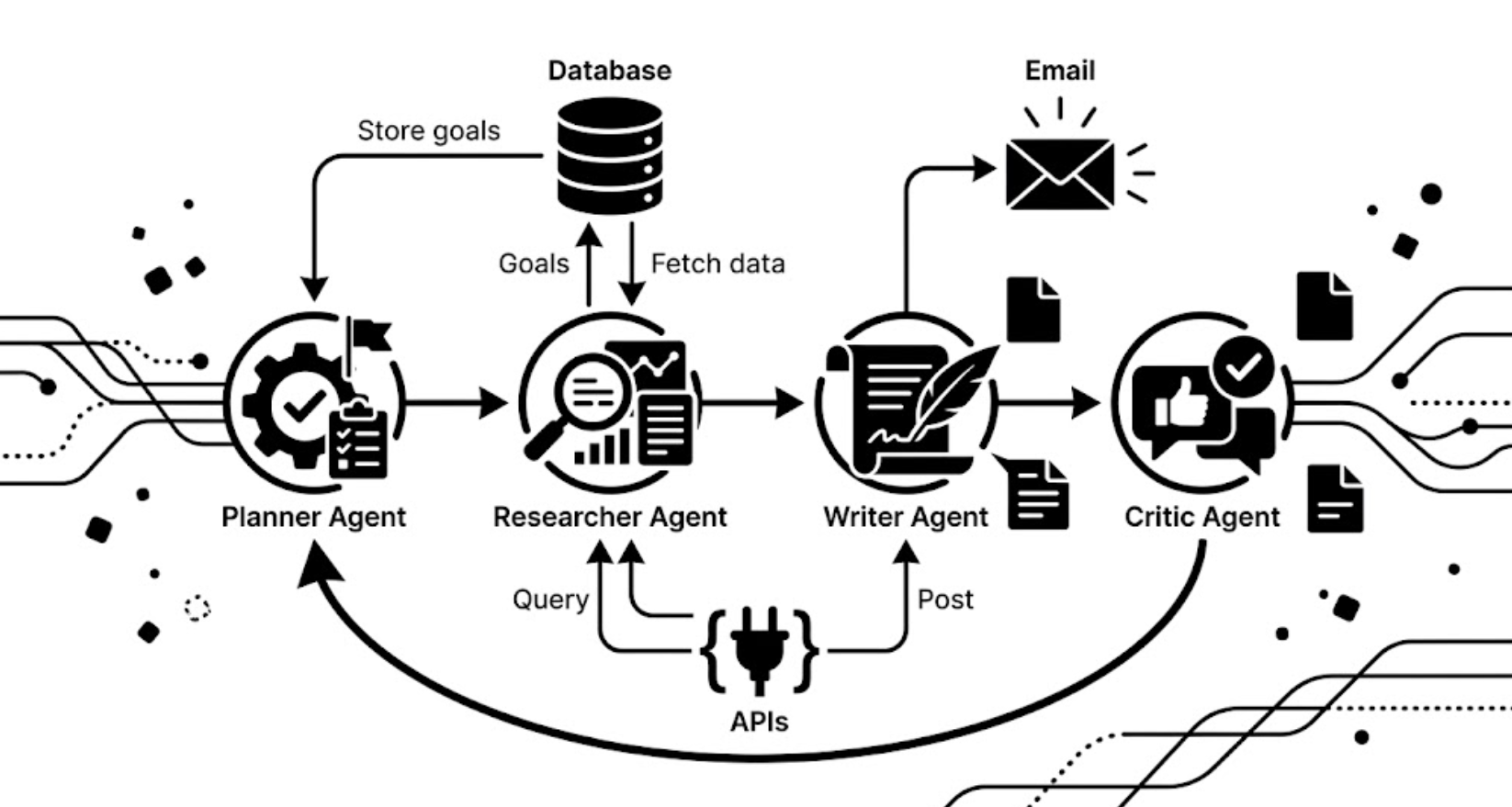
In a standard multi-agent system, a task is divided among highly specialized personas. Let's break down the ultimate AI dream team:
- The Planner Agent (The Architect):
- Role: This agent receives the initial user request and acts as the project manager.
- Function: It does no actual execution. Instead, it breaks down the monolithic goal into a sequential list of manageable, logical steps. It decides who needs to do what, and in what order.
- The Researcher Agent (The Data Gatherer):
- Role: The eyes and ears of the operation.
- Function: Equipped with tools (like SerpAPI for web searching, SQL access for internal databases, or vector store retrieval), this agent fetches real-time, factual data. It ensures the final output is grounded in reality, entirely bypassing the LLM's knowledge cutoff limits.
- The Writer/Coder Agent (The Executor):
- Role: The primary creator.
- Function: Using the structured plan from the Planner and the raw data from the Researcher, this agent generates the actual output. Whether it's drafting a highly personalized cold email, writing a Python script, or generating a financial report, this agent focuses purely on creation.
- The Critic Agent (The QA Department):
- Role: The quality control gatekeeper.
- Function: This is arguably the most important agent. The Critic reviews the Executor's work against the initial prompt and the Planner's requirements. If the code has a bug, or the text is poorly written, the Critic rejects it and forces the Executor to revise. This self-reflection loop dramatically reduces hallucinations and errors.
The Magic Formula: Connecting Agents to the Real World
Having a team of AI agents chatting with each other in a terminal window is a neat computer science trick. But how do we turn this into actual business value?
By connecting agentic architectures with powerful automation platforms like n8n, Make.com, and Zapier.
When you map an autonomous AI team to an event-driven automation platform, the result is nothing short of magical. You transform isolated AI models into an invisible, 24/7 autonomous workforce.
⚙️ Real-World Architecture: The Autonomous Customer Support Team
Let's look at how this integration looks in practice, moving from a static concept to a living, breathing workflow.
| Step | Trigger / Action | The Agentic Process |
|---|---|---|
| 1. The Trigger | Incoming Email | A frustrated customer sends an email asking for a refund because their software keeps crashing. n8n catches this via a webhook. |
| 2. Triage & Plan | The Planner Agent | n8n passes the email text to the Planner. The Planner decides: "We need the user's account history, recent crash logs, and a drafted response." |
| 3. Investigation | The Researcher Agent | Triggered by n8n, the Researcher uses API tools to query Stripe (for billing history) and Datadog/Sentry (for crash logs). It compiles a dossier. |
| 4. Drafting | The Writer Agent | The Writer reviews the dossier. It sees the customer did experience crashes due to a known server outage. It drafts a highly empathetic apology, offers a prorated refund, and explains the fix. |
| 5. Quality Control | The Critic Agent | The Critic reviews the draft against company policy. It ensures the tone is correct and the refund amount is accurate. |
| 6. The Output | Execution or Escalation | If Confidence is High: n8n automatically sends the drafted email and processes the Stripe refund via API. If Confidence is Low: n8n routes the entire dossier and draft to a human support agent's Slack channel for a final click-to-approve. |
Why This Matters Today
"This is not the future—this is what we are building today."
The transition from Copilots to Autopilots is democratizing extreme scale. Previously, the workflow described above would require a team of five human beings and hours of manual labor. Today, it takes seconds, costs fractions of a cent in API tokens, and runs relentlessly without fatigue.
Key Takeaways for Builders and Businesses:
- Stop Relying on One Prompt: If you are trying to get ChatGPT to do complex workflows in a single prompt, you are fighting a losing battle. Break tasks down.
- Embrace Frameworks: Start experimenting with CrewAI (great for beginners and Python devs) or LangGraph (incredible for complex, stateful workflows).
- Connect to Everything: Use n8n or Make.com to give your agents "hands." Let them read your emails, query your databases, and push code to your repositories.
The age of the Autopilot is here. The companies and individuals who learn to architect these multi-agent systems today will be the undisputed leaders of tomorrow. It's time to stop chatting with AI, and start deploying it.